

By Lisa Harper, July 2025
Copyright (C) 2025 Lisa Harper and the East Bay Bonsai Society
Bonsai are typically displayed in a show with an accent. This accent could be a small suiseki stone, a small figure, or most often an accent plant. Why is there an accent? In this article, I outline general guidelines gleaned from talks with Polly Gould, Young Choe, Jonas Dupuich, and by studying Japanese show books and YouTube videos from the Kokofu-ten shows, the Japanese book, “Katayama School of Keido, the Original school of Japanese Traditional Display Arrangements” by Katayama Ichiu, and David DeGroot’s book, “Principles of Bonsai Design” (which has a large chapter on bonsai display, including show design display). Keep in mind, I am not an expert and these are only my conclusions from study.
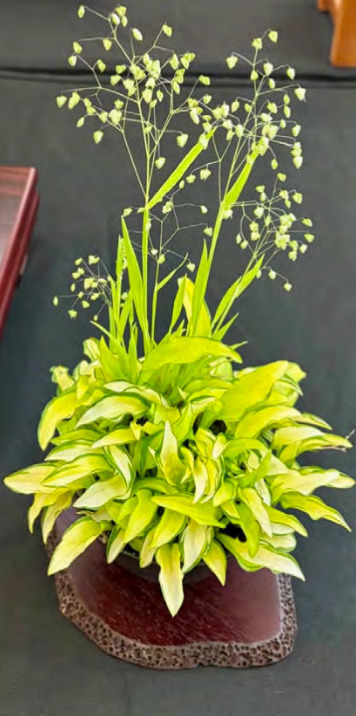
My personal interpretation of these resources allows me to offer this reason why we use accents in bonsai display. Accents can convey time of year or location, tell a story, or simply provide additional visual interest. We can also use the “Art of Bonsai Display” to elevate our trees to a higher art to tell a story or even to evoke an emotion. For example, we can strive to suggest a story of the tree’s history and hardship, or to set a mood of a lovely summer picnic underneath a California coastal redwood. The “story” of your tree can be specific or vague. The bonsai tree is always the dominant subject of your display. The eye should go to the bonsai first. The accent should be humble, secondary and should harmonize with the bonsai- not fight with it for attention. Some guidelines to achieve this especially with accent plants are below, but like other “rules” in the art of bonsai, these are general guidelines, not set in stone.
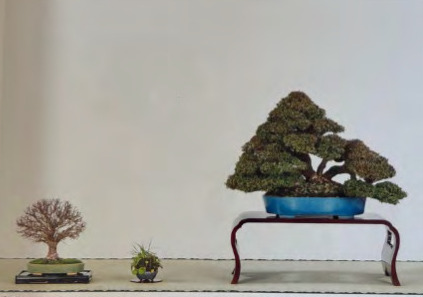
Use the accent to contribute to the story of the tree by suggesting the season (of the show) or the bonsai’s natural habitat
- The accent is most often used to suggest or accentuate the season of the show, and/or the natural habitat of where the bonsai tree grows in the wild.
- An ideal accent plant would contain plants that grow normally in the wild under the bonsai tree species you are showing. If the accent plant grows in the wild with the native bonsai tree, the accent will always be in the right season year-round. Here is an example of plants that grow with Sierra junipers from Jonas Dupuich: https://bonsaitonight.com/2019/06/25/sierra-wildflowers-natures-accent-plants/ Here is another example from iNaturalist of what grows in our native California coastal redwood forests: https://www.inaturalist.org/guides/5143
- For junipers and pines, which do not show strong seasonality themselves, a seasonally relevant accent can be important. For example, accent plants that turn red in fall would work well with evergreen conifers shown in fall.
- In general, avoid accent plants from vastly different habitats than your bonsai. For example, tropical plants are not usually appropriate with non-tropical trees.
Contrasting the accent with the bonsai helps to express the tree’s story:
- The pot of the bonsai and the accent should contrast in both shape and glaze. A bonsai in a rectangular unglazed pot could be paired with a round or oval glazed accent pot. The accent and bonsai pots should not be the same color or shape. However, the accent pot can be a similar level of artisan skill or value as the bonsai pot.
- If the bonsai is in flower, the accent should not be in flower. If the bonsai is not in flower, the accent plant can be (if in the right season), but does not have to be.
- The foliage of the bonsai should contrast with the foliage of the accent in both color and form. For example, pine bonsai could have a broad leaf accent plant such as a red oxalis. A grass accent may not work with a pine bonsai if the shape of the leaves is very similar.
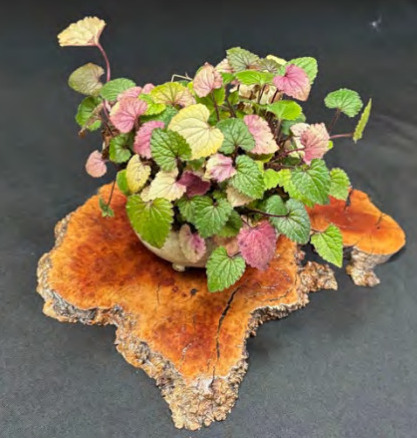
Stands:
- All bonsai trees and accent plants are displayed on a stand. The stand for the accent is less formal and less tall than the stand of the primary bonsai. Most often, accent plants are displayed on a wooden slab (or jita in Japanese). The color and texture of the bonsai and accent stands should contrast, rather than match, with the bonsai stand being the “stronger” or more dominant color and texture.
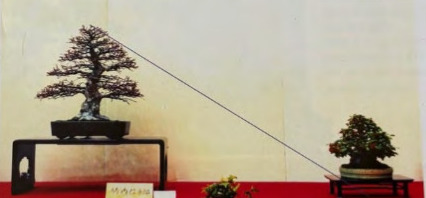
Placement of accent relative to bonsai:
- The bonsai and accent should lean towards each other, or towards the viewer.
- The accent plant should be placed in the spot where an imaginary line drawn from the bonsai crown would hit the table top (see image). You can use your arm or a straight edge to estimate placement.
- The accent plant should be forward of the bonsai.
General appearance of the accent:
- Accent plants should convey great age, like the bonsai. Some accent plants are many years old. However, accent plants can be made shortly before the show if care is taken to make them look old.
- Accent plants can contain a single species, or a few different species, generally an odd number.
- The plants should completely fill the pot, this contributes to the appearance of age.
- No soils should show. If soil is visible, it can be covered with live moss (rather than top dressing). Any kind of moss can be a feature of the accent. Imagine the tree in nature- moss is often on the shady ground in many habitats.
Relative heights of bonsai and accent: For this section, I roughly measured the relative heights of trees and accents in the 96 Kokofu-ten show book, Kokofu-ten YouTube videos, and images in David De Groots Principles of bonsai design.
- The height of the accent, including its stand, should in general not exceed the height of the top of the bonsai display stand (or, the bottom of the bonsai pot). For cascade bonsai, the accent is much shorter than the top of the cascade stand.
- For three point displays, the secondary bonsai including stand is almost always about the height of the top of the primary bonsai’s stand. The accent plant (the third point in three point displays) is not taller than the top of the secondary bonsai pot. These accents are very tiny.
- For two point display, the accent plant is a little bit larger than an accent in the three point display, but not as big as the secondary bonsai in a three point display. Accents in a two point display are never taller than the height of the primary bonsai stand and is usually shorter, giving it a very small relative appearance.
- In general, the overall height of the accent (including flowers or stalks) is never taller than one third of the height of the bonsai and its stand. Usually, the accent with its stand is 1/4 to 1/6 the height of the bonsai with its stand.
- If suiseki are used in place of an accent plant, they are even smaller than the accent plant would be.